
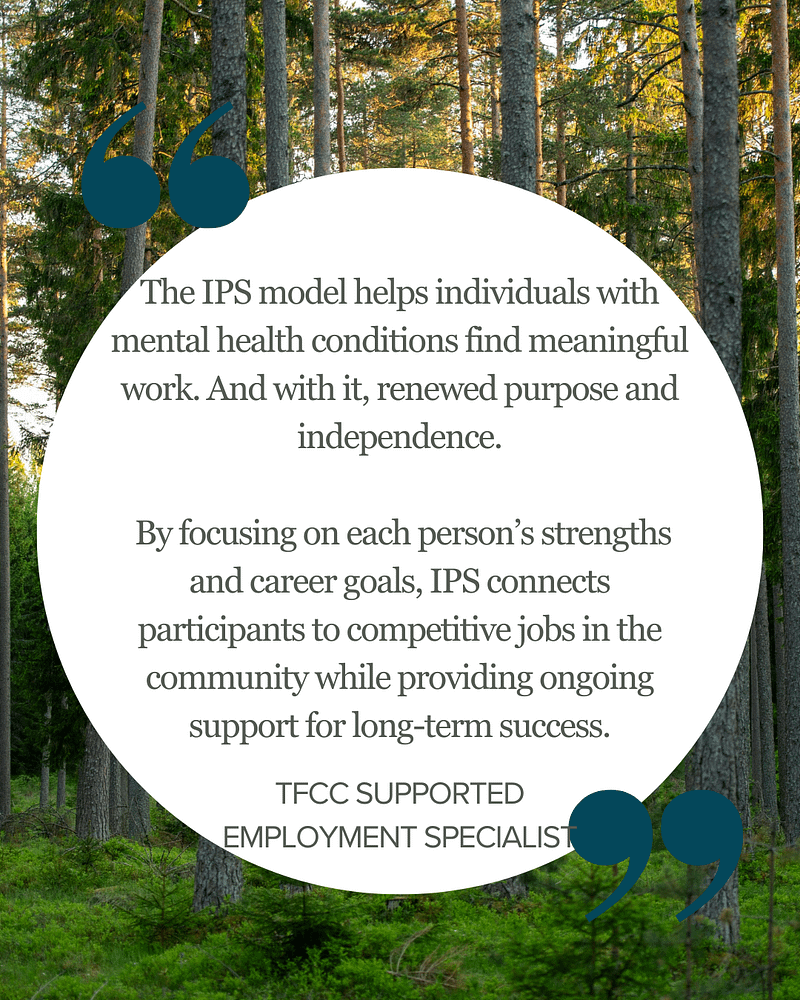
At Tillamook Family Counseling Center (TFCC), the Supported Employment Program continues to help individuals living with mental health conditions find meaningful work, renewed confidence, and greater independence. Using the evidence-based Individual Placement and Support (IPS) model, the program focuses on helping people discover employment opportunities that align with their strengths, interests, and goals while providing individualized support every step of the way.
Today, the program is supported by a collaborative team that includes Mykah Krumwiede, Supported Employment Specialist in Community Outreach, and Stephanie Allred, ACT Team Lead and Clinical Supervisor for the Assertive Community Treatment (ACT) program. Together, they work closely with clients and local employers to create opportunities that lead to long-term success.
Employment That Changes Lives
For many participants, employment becomes much more than a paycheck.
“It has been a life changer for many clients,” said Stephanie Allred. “Obtaining a job that is a good fit for someone’s skills and interests not only improves their financial situation, but gives them a sense of purpose, confidence and an opportunity to build relationships.”
TFCC staff have seen firsthand how the right employment opportunity can positively impact mental health and overall well-being. Stephanie shared that many clients have previously struggled in positions that were not a good fit for their interests or abilities, often leading to discouragement and loss of confidence.
“We have seen many clients try to be in jobs that are just not a good fit for them, then they lose confidence,” she said. “It is satisfying to help clients find a job that matches their interests and have a more positive experience.”
An Individualized Approach to Success
What makes the program especially effective is its individualized support system. Rather than taking a one-size-fits-all approach, the team works closely with each client to understand their unique skills, interests, goals, and readiness for employment.
“The individualized approach, developing relationships with employers and providing support through the whole process” is what makes the program successful, Stephanie explained. That process includes starting with assessment and exploration, job search, applying, and coaching after starting a job.
The program also develops relationships with local employers to better understand workplace environments, available positions, and the qualities employers are seeking in candidates. This relationship-based approach helps TFCC connect clients with employers that are the best possible fit.
“We do a thorough assessment of our client’s skills, interests and abilities,” Stephanie said. “We also develop relationships with local employers to know what they are looking for, the types of jobs they have open and the work environment.”
By understanding both the needs of clients and employers, TFCC can create stronger employment matches that are more likely to succeed long term.
“We can then develop profiles for both clients and employers and connect clients with a ‘best fit’ employer,” Stephanie added. “We also match a client’s requested pace. Some clients want to get to work quickly, others have been out of the workforce for some time and want to start with exploration.”
Overcoming Barriers in a Small, Coastal Community
In a rural community like Tillamook County, barriers such as gaps in employment, mental health challenges, or legal history can make finding work more difficult for some individuals.
“Being in a small community can be difficult at times,” Stephanie shared. “Some of our clients have a legal history or have lost jobs when their illness was not well managed, giving them a bad reputation. It takes some effort to convince employers to give someone a chance.”
Despite these challenges, TFCC continues to advocate for clients, build relationships with local employers, and create opportunities for individuals who are ready to contribute to the workforce.

Looking Ahead
TFCC hopes to continue expanding relationships with employers and increasing awareness about the Supported Employment Program throughout Tillamook County.
“Up to 80% of jobs are not even posted,” Stephanie noted. “We hope that all TFCC staff are asking their friends and neighbors about where they work, what job opportunities are available, and encouraging managers and employers to collaborate with our employment specialist.”
The more opportunities available, the greater the likelihood that clients will find meaningful employment that aligns with their abilities and interests.
Stories of success continue to demonstrate the impact of the IPS model. Clients who once struggled to maintain employment are now building stable careers, gaining independence, and becoming more connected within the community. Through personalized support and strong partnerships, TFCC’s Supported Employment Program is helping individuals not only find jobs, but rebuild their lives and create hopeful futures.
